Businesses today are expected to move faster, operate leaner, and make smarter decisions than ever before. Whether it is managing production, tracking assets, reducing downtime, or improving customer service, companies need systems that deliver accurate information in real time.
That is exactly where B2B IoT Solutions are making a difference.
The Internet of Things (IoT) has moved far beyond consumer gadgets and smart home devices. In the business world, IoT is now being used to connect machines, sensors, vehicles, tools, and infrastructure so companies can monitor operations, automate tasks, and respond quickly to changing conditions.
For many organizations, IoT is no longer an experimental technology. It has become a practical business tool that improves efficiency, reduces waste, and creates stronger long-term growth.
What Are B2B IoT Solutions?
B2B IoT Solutions are connected technology systems built specifically for business operations. They allow physical devices to collect data, communicate with other systems, and trigger useful actions automatically.
In simple terms, IoT gives businesses better visibility into what is happening across their operations.
Examples include:
- Sensors that detect machine temperature or vibration
- GPS devices that track delivery vehicles
- Smart meters that monitor energy use
- Connected inventory systems in warehouses
- Building sensors that control lighting and climate
Instead of relying on manual reports or delayed updates, businesses can see live information and act immediately.
Why Businesses Are Adopting IoT Faster Than Ever
Companies are investing in IoT because the business case is clear. Better information leads to better decisions, and better decisions lead to stronger performance.
Improved Operational Efficiency
Many everyday business tasks still depend on manual checks, spreadsheets, or reactive maintenance. IoT automates much of this work and reduces delays.
For example, instead of checking equipment by hand, sensors can continuously monitor performance and alert staff only when attention is needed.
Lower Operating Costs
Waste often comes from problems that go unnoticed—energy overuse, equipment failure, poor route planning, or idle assets. IoT helps identify these hidden costs quickly.
Real-Time Visibility
Managers no longer need to wait for weekly reports. Live dashboards can show production output, fleet movement, stock levels, or system performance instantly.
Better Customer Experience
Businesses that run efficiently usually serve customers better. Faster deliveries, fewer delays, and improved service reliability all contribute to stronger customer trust.
Easier Scaling
As a company grows, connected systems can grow with it. Adding new locations, devices, or teams becomes easier when operations are already digitized.
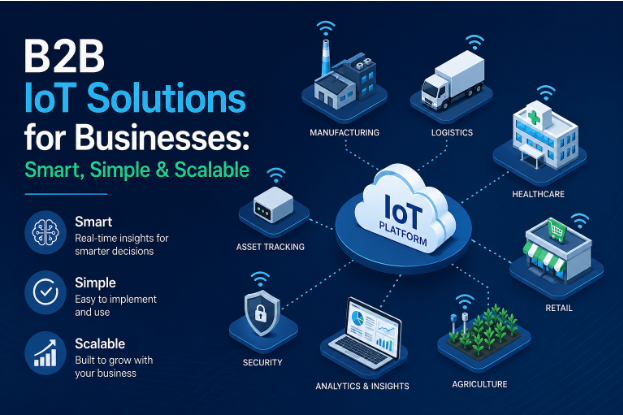
Where B2B IoT Solutions Deliver the Most Value
IoT can be applied in almost any industry, but some sectors see especially strong returns.
Manufacturing
Manufacturers use IoT to monitor machinery, production lines, and factory conditions.
Common benefits include:
- Predictive maintenance
- Reduced machine downtime
- Better quality control
- Lower energy consumption
- Safer working environments
A factory that prevents breakdowns before they happen can save significant time and money.
Logistics and Transportation
Supply chains depend on timing, visibility, and coordination. IoT improves all three.
Businesses use connected systems for:
- Vehicle tracking
- Route optimization
- Fuel monitoring
- Driver behavior insights
- Shipment condition monitoring
For temperature-sensitive goods such as food or pharmaceuticals, real-time monitoring is especially valuable.
Warehousing
Warehouses need accuracy and speed. IoT helps streamline movement, stock control, and asset use.
Examples include:
- Smart inventory tracking
- Barcode or RFID automation
- Equipment usage monitoring
- Environmental controls
- Faster picking and dispatching
Healthcare
Hospitals, clinics, and care providers use connected devices to improve both patient care and operational efficiency.
Applications include:
- Remote patient monitoring
- Medical equipment tracking
- Temperature monitoring for medicines
- Smart facility management
- Automated alerts for critical devices
Retail
Retailers use IoT to improve store operations while learning more about customer behavior.
Examples include:
- Smart shelves
- Inventory visibility
- Queue management
- In-store analytics
- Energy-efficient store systems
What Makes a Successful IoT System?
A strong IoT deployment is not just about sensors. It requires several parts working together smoothly.
Smart Devices
These are the sensors, trackers, meters, or machines collecting useful information.
Reliable Connectivity
Devices need dependable communication through Wi-Fi, cellular networks, Bluetooth, LPWAN, or other technologies depending on the use case.
Cloud or Edge Processing
Collected data must be stored, processed, and analyzed. Some businesses use cloud platforms, while others process data closer to the device for faster response times.
Dashboards and Alerts
Raw data has little value without clarity. Good dashboards turn data into insights teams can actually use.
Integration with Existing Systems
The best IoT solutions connect with ERP, CRM, warehouse software, or maintenance systems already in use.
Real Examples of Business Impact
To understand the real value of B2B IoT Solutions, consider these everyday scenarios.
Preventing Equipment Failure
A manufacturing company installs vibration sensors on key machines. Instead of waiting for breakdowns, the system flags unusual patterns early so maintenance can be scheduled in advance.
Reducing Delivery Delays
A logistics business tracks every vehicle in real time and reroutes drivers around traffic. Customers receive more accurate delivery updates.
Lowering Utility Costs
An office building uses occupancy sensors and smart climate control systems. Energy use drops because lighting and cooling only run when needed.
Protecting Temperature-Sensitive Goods
A cold storage company receives instant alerts if refrigeration levels move outside the safe range, helping avoid spoiled stock.
Why Small and Mid-Sized Businesses Should Pay Attention
IoT is often seen as something only large enterprises can afford. That is no longer true.
Today, cloud platforms, affordable sensors, and subscription-based software have made IoT accessible to smaller companies as well.
Small and mid-sized businesses can start with focused projects such as:
- Tracking high-value assets
- Monitoring equipment health
- Reducing electricity bills
- Improving warehouse accuracy
- Managing field teams remotely
Often, a small successful pilot project creates enough return to justify expansion.
How to Choose the Right B2B IoT Solutions Partner
Technology matters, but choosing the right implementation partner matters just as much.
Look for a provider that offers:
Business Understanding
They should understand your operational challenges, not just sell hardware.
Customization
Every business has different workflows. A solution should fit your processes rather than force you to adapt unnecessarily.
Security Standards
Connected devices must be protected with secure access controls, updates, and encryption.
Scalability
What works for ten devices should also work for one thousand if growth demands it.
Long-Term Support
Deployment is only the first stage. Maintenance, upgrades, and monitoring are equally important.
Common Challenges and How Smart Companies Solve Them
No digital transformation project is perfect. IoT has challenges, but most are manageable with proper planning.
Too Much Data
Many businesses collect more data than they can use. The solution is to focus on meaningful metrics tied to real business goals.
Legacy Systems
Older software can be difficult to integrate. Experienced development teams can bridge old and new systems through APIs or middleware.
Security Concerns
Any connected environment needs strong cybersecurity practices, device authentication, and regular patching.
Internal Resistance
Employees may worry about change. Adoption improves when teams understand how IoT helps them do their jobs better.
Future Trends in B2B IoT Solutions
The next phase of IoT will be even more intelligent and efficient.
AI-Powered Insights
Artificial intelligence can analyze sensor data faster than humans and detect patterns before problems become visible.
5G Connectivity
Faster and more stable networks will improve large-scale deployments and mobile systems.
Edge Computing
Processing data locally reduces delays and supports faster automation decisions.
Sustainability Monitoring
More companies are using IoT to track emissions, water use, and energy performance.
Why Now Is the Right Time to Invest
Businesses that delay modernization often end up paying more later through inefficiency, downtime, and lost competitiveness.
The good news is that adopting IoT does not require rebuilding everything at once.
Many successful companies begin with one clear objective:
- Reduce maintenance costs
- Improve delivery performance
- Track assets better
- Cut energy waste
- Increase production visibility
Once results are proven, expansion becomes much easier.
Final Thoughts
B2B IoT Solutions are no longer optional for businesses that want to stay efficient and competitive. They offer practical value: better visibility, lower costs, faster response times, and smarter growth.
The most successful IoT strategies are not built around hype. They are built around solving real business problems with simple, scalable technology.
Whether you run a factory, logistics network, warehouse, retail operation, or service business, the right IoT solution can transform everyday operations and create lasting advantages.